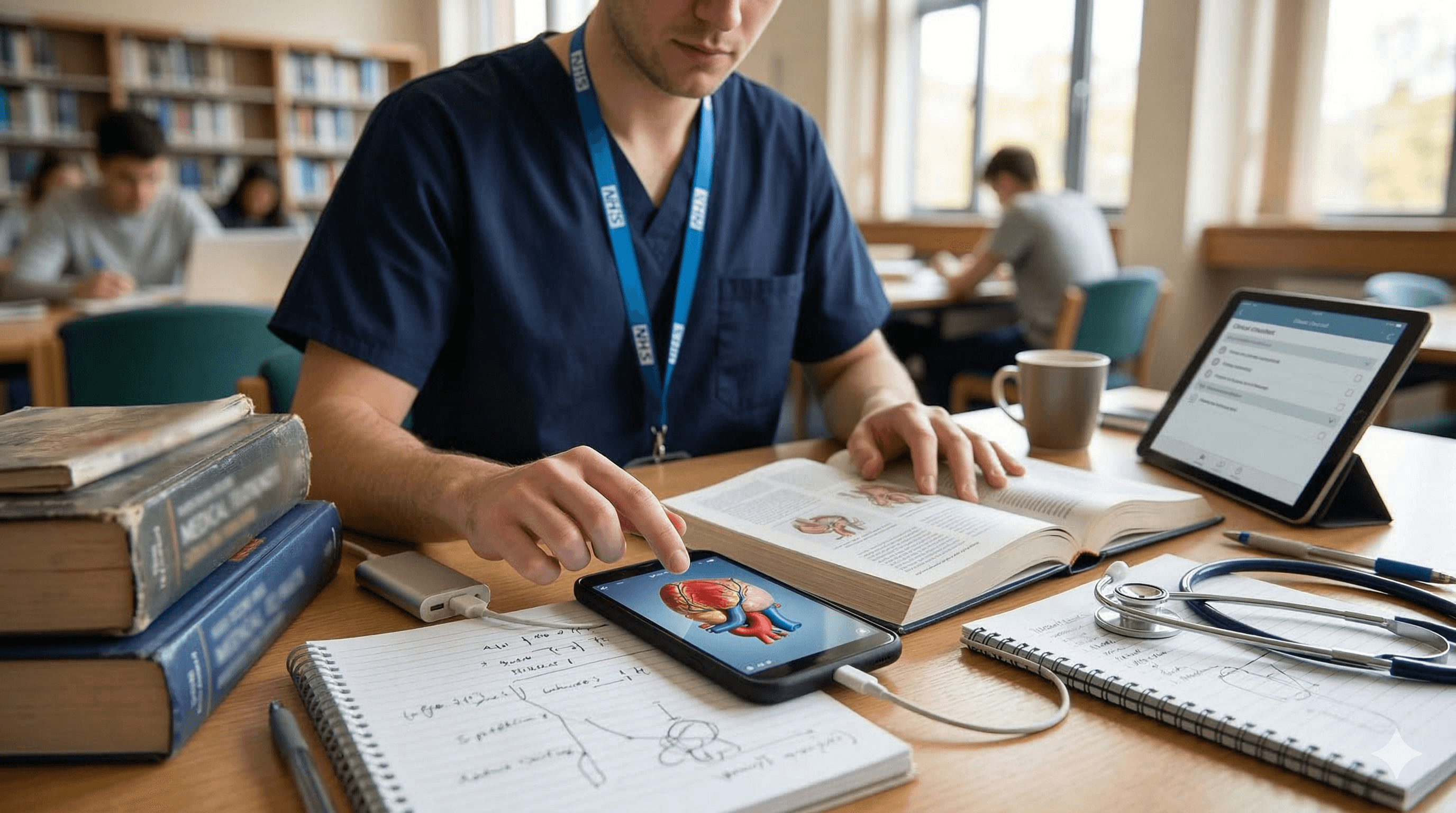
Most “best apps for medical students” lists are too shallow to be genuinely useful. They usually rank features rather than workflows. But that is not how students actually use their phones. In practice, most people do not consistently use ten different apps. They use a small handful that solve recurring problems quickly: understanding anatomy, rehearsing OSCEs, building question volume, checking a drug, getting used to NHS-style guideline thinking, or clarifying something they have half-understood on placement.
That is why the best app for a second-year student trying to understand brachial plexus anatomy is not the best app for a final-year student trying to survive placements, build UKMLA stamina, and stop second-guessing common prescribing decisions. The right stack changes across the course. And now that the UK Medical Licensing Assessment underpins what all UK medical graduates must be ready for, app usefulness has to be judged partly against that backdrop as well.
So this is not a flat top-ten ranking. It is a practical guide to the best apps and mobile-first tools for different moments of need in UK medical school, with a deliberately UK-specific lens.
What do medical students in the UK actually need apps for?
Before choosing any app, it helps to be honest about the job you are really hiring it to do.
Anatomy
Anatomy apps are most useful when a student needs layered visualisation, repeated spatial revision, topic-specific quizzes, and quick refreshers before teaching. This is why dedicated anatomy tools still matter. Anatomy is not just another subject folder. It is unusually spatial, cumulative, and easy to forget if you revise only verbally.
That is where TeachMeAnatomy stands out. It is explicitly anatomy-first rather than trying to be a general medical-school ecosystem. Its current platform positioning emphasises an integrated anatomy textbook, interactive 3D models, quiz banks, flashcards, and dissection images, which makes it strong for students who need anatomy to become visual rather than verbal.
OSCEs and practical skills
OSCE preparation is its own category because practical performance is not the same as written knowledge. Students preparing for OSCEs need stepwise structure, examiner checklists, repetition, realistic consultation flow, and ideally something they can use even when a study partner is not available.
Geeky Medics is the clearest anchor here. Its current clinical-skills platform publicly emphasises 1,300-plus OSCE stations, interactive examiner checklists, virtual patients, AI tools, and group-practice workflows. That makes it especially good for students who need history-taking structure, examination fluency, and practical station rehearsal rather than just another question bank.
Question practice
Question-bank apps matter because they convert passive reading into retrieval practice. They help with stamina, timing, weak-area detection, and exam pattern recognition. This becomes increasingly important as finals and the UKMLA approach.
For UK students, Quesmed and PassMedicine are two of the most recognisable anchors in this lane. Quesmed is explicitly positioned around UKMLA, PLAB, MRCP and related exams, while PassMedicine remains one of the most familiar UK revision brands for high-volume SBA-style drilling.
Note revision and spaced reinforcement
Not every useful app is about new content. Some are about making revision portable enough to use dead time well. Students often need quick review, flashcards, short quizzes, or mobile repetition rather than another large desktop-only platform.
Osmosis is a strong visual-learning anchor here because its mobile app emphasises videos, quizzes, flashcards, and synced study across devices. Quesmed also matters in this category because its broader platform is no longer just questions; it also includes notes, mocks, and mobile use that makes it easier to revise in short bursts.
Prescribing and guideline familiarisation
Medical students do not need to be prescribing experts. But they do need to become familiar with the UK medicines-and-guidelines ecosystem they will actually meet in practice. That means beginning to recognise how UK drug information, treatment summaries, and common-condition guidance are organised.
The BNF matters here because it is the UK’s core medicines reference, available online and as a mobile app. NICE CKS matters because it provides concise evidence-based summaries and practical advice on common primary care topics. Neither is a student “revision app” in the usual sense, but both become increasingly valuable as students move closer to finals, assistantships, and FY1-style thinking.
Quick clinical clarification on placement
This is one of the most common but least well served needs. You see something on placement. You half-understand it. You want a fast, structured answer before or after teaching. But you do not want to disappear into a one-hour literature rabbit hole.
AMBOSS is one of the strongest anchors here. Its current positioning emphasises high-powered search, online and offline mobile access, a large knowledge library, and a UKMLA study guide inside its student-facing ecosystem. That makes it particularly strong for students who want one mobile tool that can support both structured study and rapid clinical clarification on placement.
By the end of this decision framework, the main point should be clear: the rest of the article is about matching tool to job, not crowning a single universal winner.
How to judge a medical student app properly
The best app is not always the most sophisticated one. It is the one that reliably gets opened when you have three minutes, ten minutes, or half an hour.
A few criteria matter more than everything else.
Task fit
Does it actually solve the problem you have? A brilliant OSCE app is not useful if your bottleneck is anatomy. A giant question bank is not the answer if you are struggling to understand physiology in the first place.
Mobile usability
There is a difference between being technically available on a phone and being genuinely useful on a phone. Some platforms are truly built for mobile revision; others are effectively desktop products that happen to have an app.
Offline access
This matters more than people admit. Commutes, patchy hospital signal, and short gaps between teaching sessions all make offline access disproportionately valuable. AMBOSS, Osmosis, Quesmed, PassMedicine, and BNF all publicly emphasise app-based or offline-capable access in one form or another.
UK relevance
This is one of the most important filters for UK students. Does the tool help with UKMLA-style preparation, NHS-style practice exposure, or familiarity with UK prescribing and guideline culture? A platform can be excellent and still not be especially well aligned with UK finals or early NHS transition.
Depth versus speed
Some apps are for understanding. Others are for drilling. Others are for quick checking. Problems arise when students expect one category of app to do the job of another.
Practicality
Does the app save time, or simply add another platform to maintain? The marginal value of the fifth app is usually low.
Stage of training
The right app stack for first year is different from the right stack for finals. Your needs should shape the subscription list, not the other way round.
The best apps for medical students in the UK by category
This is the most practical way to think about the market: not as one ranked top ten, but as a set of “best for” decisions.
Best anatomy app: TeachMeAnatomy
Best for: students who need anatomy to become visual rather than verbal.
TeachMeAnatomy is strongest when lecture slides and anatomy lists stop being enough. Its public product positioning is unusually focused: integrated textbook content, interactive 3D models, dissection images, flashcards, and a large anatomy question bank. That makes it especially useful for pre-clinical anatomy, surgery and MSK refreshers, last-minute anatomy review before teaching, and any student who struggles to hold structures in their mind unless they can manipulate them visually.
Why it works: it is clearly anatomy-first. It does not dilute its usefulness by trying to be a full exam ecosystem.
Where it is weaker: it is not a ward-placement clarification app, a guideline tool, or a complete finals-revision platform.
Best OSCE app: Geeky Medics
Best for: history-taking structure, examination sequence, station rehearsal, and practical fluency.
Geeky Medics remains one of the clearest choices for OSCE-focused preparation in the UK. Its current platform emphasises step-by-step OSCE guides, a large station bank, virtual patients, interactive examiner checklists, and AI-supported practice tools. That is exactly the kind of structure students need when they are short on study partners, trying to build consistency across station types, or rehearsing the rhythm of a consultation rather than merely memorising facts.
Why it works: it is tightly matched to practical-skills preparation, and it reflects the way UK students actually prepare for stations.
Where it is weaker: it is strongest in OSCE and practical-skills preparation, not as a full all-purpose medical-school platform.
If you want the broader reasoning and clarification layer that can sit next to OSCE prep, the internal next stop is How iatroX works and the Clinical Q&A Library.
Best all-round study and placement app: AMBOSS
Best for: students who want one mobile tool that can support both structured study and quick clinical clarification.
AMBOSS is one of the most convincing all-rounders because it spans several jobs at once. Its official positioning highlights high-powered search, online and offline access, a knowledge library, question-bank tools, and a dedicated UKMLA study guide. It also explicitly presents itself as useful in clinical rotations and on the wards, not just during desk-based revision.
That combination makes it especially valuable for clinical years, finals, and students who do not want to juggle five separate systems. It is broad rather than hyper-specialised, but that breadth is exactly what many students want once medicine starts to feel less modular and more integrated.
Why it works: it is one of the clearest examples of a study-plus-clarification platform rather than a single-purpose app.
Where it is weaker: because it is broad, some users will still prefer a separate dedicated anatomy or OSCE tool.
Best app for visual learning: Osmosis
Best for: students who understand better through short, illustrated conceptual explanations than through pure question repetition.
Osmosis has long occupied the visual-learning lane, and its current mobile positioning continues that logic. Videos, quizzes, notes, flashcards, and offline study make it useful for pre-clinical years, difficult systems topics, and moments where a textbook simply feels too dense to rescue a topic quickly.
This makes Osmosis particularly useful as a support layer. It is not inherently UK-first, so it is less convincing as a full UKMLA strategy on its own. But it is very effective when the problem is understanding rather than lack of effort.
Why it works: it turns complex concepts into something easier to grasp quickly and revisit repeatedly.
Where it is weaker: it is better as a conceptual support layer than as a full UK-specific finals strategy.
Best app for UKMLA mobile question practice: Quesmed
Best for: students who want a UK-focused, mobile-friendly exam preparation tool.
Quesmed is particularly relevant in the UK because it is clearly positioning itself around UKMLA and related medical exams. Its public product pages emphasise UKMLA-focused question banks, mock tests, OSCE prep, a knowledge library, progress tracking, and mobile app access, including offline use.
That makes it strongest for clinical years, finals, and UKMLA-focused students who want exam drilling plus structured tracking in a specifically UK-oriented product.
Why it works: it is clearly aligned to UK medical exam workflows rather than acting as a generic global study app.
Where it is weaker: it is less useful as a pure anatomy tool or a concept-visualisation platform.
Best app for building exam stamina: PassMedicine
Best for: students who want large-volume repetition and consistent exam drilling.
PassMedicine remains deeply embedded in UK revision culture for a reason. Its current app positioning emphasises offline question access, synced sessions, mobile textbook access, and its knowledge tutor. For students whose main problem is not starting revision but accumulating enough high-volume reps to become exam-hardened, it remains a very sensible choice.
This is especially true for finals, UKMLA-style preparation, and students who benefit from heavy question repetition rather than highly aesthetic learning environments.
Why it works: it is built for disciplined, repeated exposure to exam-style questions.
Where it is weaker: like most question-bank-first products, it is strongest when paired with a separate explanation or clarification layer.
Best app for prescribing familiarity: BNF
Best for: students starting to orient themselves to UK medicines information.
The BNF is not a revision platform in the usual sense, but it is one of the most important things to become familiar with as you move closer to real clinical work. NICE describes it as providing key information on the selection, prescribing, dispensing, and administration of medicines, and BNF content is available online and via the BNF + BNFC app, including offline access.
For students, the value is not “learning the whole BNF”. The value is becoming familiar with UK drug monographs, dose structures, safety information, and how medicines information is actually organised in NHS-facing practice.
Why it works: it gives early, realistic exposure to the UK medicines ecosystem.
Where it is weaker: it is a practice-facing reference tool, not a structured revision app.
Best UK guideline-familiarity tool worth bookmarking: NICE CKS
Best for: students who want to start thinking in concise, evidence-based UK management summaries.
It is worth being precise here. NICE CKS is not really a “student app” in the same sense as AMBOSS, Quesmed, or Geeky Medics. It is better understood as a UK clinical reference resource worth bookmarking on your phone. NICE describes it as providing primary care practitioners with readily accessible summaries of the current evidence base and practical advice on best practice.
That is why it becomes useful for students on placement, finals students trying to think more like NHS clinicians, and anyone who wants to get used to how common UK problems are framed in concise management terms.
Why it works: it helps students move beyond abstract textbook thinking and toward UK guideline structure.
Where it is weaker: it is not a student-first revision product and should not be treated as a substitute for structured exam prep.
What makes an app genuinely useful for medical students in the UK?
This is where the UK-specific lens really matters.
UKMLA relevance
The MLA now shapes what “useful” means for UK medical students. The GMC says all medical students graduating from UK universities need to pass the MLA before joining the medical register, and the content map is explicitly underpinned by readiness for safe practice, managing uncertainty, and delivering person-centred care. That means tools that support applied reasoning, practical skills, and safe-practice thinking deserve more weight than generic memorisation tools alone.
NHS-facing workflow exposure
UK students benefit from getting used to the ecosystem they will actually meet in practice. That means familiarity with BNF, NICE guidance, NICE CKS, and resources that reflect day-to-day NHS reasoning, not just global medical education content.
Prescribing and guideline culture
Students should not revise only from abstract textbooks. They should gradually become comfortable with how treatments, indications, and concise management guidance are organised in UK practice. That familiarity reduces friction later.
UK-led versus US-led apps
This is one of the most useful distinctions in the article.
US-led apps can be excellent for conceptual explanation, integrated library tools, and broad study support. UK-focused apps often perform better for local exam patterning, OSCE style, and early guideline familiarity. In practice, the best stack is often one broad concept or all-round tool plus one explicitly UK exam-focused tool.
That is where the article becomes more than a list.
A minimal app stack for each stage of medical school
One of the most useful ways to think about app choice is to build the leanest stack that actually covers your needs.
First and second year
Keep it simple.
A sensible lean stack is:
- one concept app
- one anatomy app
- optional flashcards or note reinforcement
For many students, that means TeachMeAnatomy + Osmosis if they are concept- and visual-heavy learners, or TeachMeAnatomy + AMBOSS if they want an anatomy layer plus a broader study platform.
Clinical years
By clinical years, the stack should become more placement-friendly.
A sensible stack is:
- one explanation or placement-friendly app
- one OSCE app
- one UK reference app
For many students, that means AMBOSS + Geeky Medics + BNF, with NICE CKS bookmarked for common-condition or primary-care familiarity.
Finals and UKMLA
At this stage, students usually need:
- one main Q-bank app
- one OSCE and practical-skills app
- one quick clarification app
A strong stack is Quesmed or PassMedicine + Geeky Medics + AMBOSS, with BNF as a supplementary prescribing reference.
Aspiring junior doctor
As students move towards assistantship and FY1-style thinking, the stack should feel more practice-facing.
A sensible setup is:
- one question or knowledge app
- BNF
- NICE CKS
- one practical-skills app if history or examination structure still needs work
The key point is that the app stack should feel narrower and more realistic as graduation approaches, not broader.
What to avoid when choosing study apps
This is where many students lose money and time.
App overload
The marginal benefit of the fifth study app is usually low. Most students do better with one strong daily-use app and one or two targeted companions than with a graveyard of unused subscriptions.
Replacing deep study with snackable study
Mobile learning is useful, but it should support serious study rather than masquerade as a full replacement. Short bursts are excellent for reinforcement. They are not enough on their own.
Using reference tools as though they were revision systems
This distinction matters. BNF and NICE CKS are not substitutes for structured revision. They are reference habits that become increasingly valuable as students move closer to practice.
Mistaking polish for fit
A visually impressive app may still be the wrong tool for UKMLA, OSCEs, or placements. Product polish is not the same as educational fit.
Where iatroX fits in a student app stack
The most credible way to position iatroX is not as “the only app you need”. That would weaken the article.
A stronger and more believable framing is that iatroX sits between static resources and interactive clarification. It is useful when a student wants to turn confusion into understanding quickly, complement question banks and reference tools, and add an explanation layer rather than simply another pile of notes.
If BNF helps you check, Geeky Medics helps you perform, and a Q-bank helps you drill, iatroX fits best as the clarification layer that helps you understand what you are looking at and why it matters.
That is why the most relevant internal routes here are:
FAQs
Are paid apps worth it for medical students in the UK?
Often yes, but only when the app solves a recurring problem. One strong paid app used daily is usually more valuable than several neglected subscriptions.
Which apps matter most for finals?
Usually one Q-bank, one OSCE tool, one clarification or reference layer, and optionally BNF for prescribing familiarity.
Should I choose a Q-bank app or an anatomy app first?
Usually anatomy-first in earlier years, then Q-bank-first as finals and the UKMLA approach.
What should I keep on my phone during placements?
One fast clarification tool, one practical-skills tool, BNF, and optionally bookmarked NICE CKS pages for common-condition familiarity.
Are NICE CKS and BNF revision apps?
No, not really. They are clinical reference tools that become increasingly useful as students move toward real practice.
Conclusion
The best apps for medical students in the UK are the ones that reduce friction at the exact point where students get stuck: not understanding, not remembering, not rehearsing enough, or not feeling ready for the reality of UK practice.
That is why the right answer is rarely a flat ranked list.
TeachMeAnatomy is strongest for anatomy.
Geeky Medics is strongest for OSCEs and practical fluency.
AMBOSS is strongest as an all-round study-plus-placement app.
Osmosis is strongest for visual and conceptual rescue.
Quesmed is strongest for UKMLA-focused mobile question practice.
PassMedicine is strongest for exam stamina through repetition.
BNF is strongest for prescribing familiarity.
NICE CKS is strongest as a UK guideline-familiarity tool worth bookmarking.
And iatroX fits best as the clarification layer between revision, reference, and real clinical understanding.
If you want the next practical step, explore How iatroX works, the Clinical Q&A Library, the A-Z Clinical Knowledge Centre, and the wider Compare pages to build a stack that actually matches your stage of training.